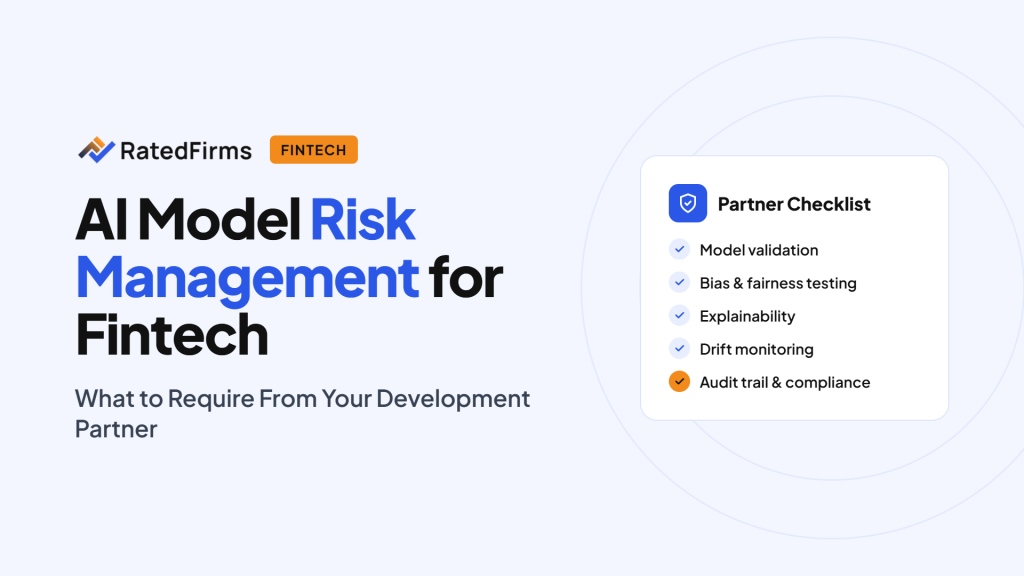
AI model risk management is the set of controls that proves a model is fit for its purpose, works as intended and is watched after launch. If you hire a firm to build AI for a fintech or bank, the model-risk evidence should be a contract deliverable, not something your team reconstructs later. This guide explains what changed in US guidance in 2026 and lists the documents and controls to require from any AI development partner.
What changed in April 2026
On 17 April 2026, the OCC, Federal Reserve and FDIC issued revised model risk management guidance (SR 26-2 at the Fed, OCC Bulletin 2026-13). It replaced the 2011 guidance known as SR 11-7, the 2021 interagency statement on models used for anti-money laundering, and related OCC material, according to a Sullivan & Cromwell summary.
Four changes matter most to buyers. The definition of a model narrowed to “complex” quantitative methods, so simple rule-based logic falls outside it. Oversight now scales with materiality, judged by a model’s purpose and its exposure, and models built to meet regulatory requirements are generally treated as higher risk. The fixed annual validation cycle is gone in favor of a principles-based approach. And generative and agentic AI are explicitly excluded as “novel and rapidly evolving,” with banks told to govern them through their broader risk practices. Traditional statistical and non-generative machine learning models stay in scope.
The guidance says it sets no enforceable standards, and the agencies plan a request for information on model risk, including AI. That doesn’t make it optional in practice: examiners and bank partners use it as the reference point for what good looks like.
Why this matters if you are not a bank
Most fintechs are not supervised under SR 26-2 directly. But if you lend through a sponsor bank, sell software to banks, or process payments for them, your models end up inside a bank’s inventory and its third-party reviews. State examiners now have a CSBS AI supervisory framework, released 16 September 2026, that asks institutions to inventory AI use cases and say whether each tool was built in-house or supplied by a third party (Ballard Spahr).
Our update on the new third-party risk proposal covers the vendor side in more detail.
Lenders also carry their own obligations. Under the Equal Credit Opportunity Act and Regulation B, applicants who are denied credit must get the specific principal reasons. A model that can’t produce those reasons can’t be used for the decision, however accurate it is.
Eight deliverables to require from an AI development partner
Put these in the statement of work, with acceptance criteria. A partner with real financial-services experience will recognize the list and price it properly.
- Model card and purpose statement. What the model decides or supports, who uses the output, what it must not be used for, and the materiality tier you and the partner agree on.
- Data lineage and quality report. Sources, date ranges, exclusions, label definitions (for example, what counts as default or fraud) and known gaps, including any reject-inference approach for declined applicants.
- Methodology and alternatives. Why this algorithm was chosen over simpler options, with a benchmark against your current rules or scorecard.
- Validation pack. Out-of-time and out-of-sample results, stability tests, sensitivity analysis and limits, written so an independent validator can reproduce them.
- Explainability outputs. Global feature importance plus decision-level reason codes, and for credit, a mapping from model reasons to adverse action notice language.
- Fairness testing. Disparate-impact analysis on relevant groups (or proxies, where you can’t collect protected attributes), with the less-discriminatory alternatives considered.
- Monitoring plan. Metrics, thresholds, data-drift checks, who receives alerts, and what triggers retraining or rollback.
- Change log and handover. Versioned code, model weights, features and training data snapshots, so your team or a new vendor can retrain the model without the original builder.
Generative and agentic AI: govern them anyway
The exclusion of generative and agentic AI from SR 26-2 doesn’t mean “no rules.” It means the bank’s broader risk framework applies, and every bank fills that gap differently. In October 2026 the Financial Stability Board published a consultation on sound practices for responsible AI adoption, with four governance practices and eight lifecycle practices, and it warned that AI agents can behave differently as they gain new tools or prompts (PYMNTS).
For LLM assistants and agents, add these to the deliverables above: an evaluation set built from real tasks with pass/fail criteria; hallucination and grounding tests against approved sources; prompt-injection and data-leakage testing (the OWASP Top 10 for LLM Applications is a useful checklist); a log of every action an agent takes; human approval for any step that moves money, changes a customer record or communicates a decision; and a kill switch. The NIST AI Risk Management Framework gives a neutral structure (govern, map, measure, manage) that both sides can map these controls to.
Also ask which third-party foundation model sits underneath, how the partner will be told about model version changes, and whether your data can be used for training. A vendor update can change behavior overnight, so change control has to cover the supplier’s supplier.
Contract clauses that make the deliverables stick
Model-risk documents are only useful if you can get them, update them and use them in an exam. Ask for:
- Ownership of model weights, code, features and labelled data you paid to create, with licenses listed for anything the partner reuses.
- Audit and information rights that let your validators, auditors and, where relevant, your bank partners and regulators review the work.
- Notice periods for changes to underlying models or subcontractors.
- Incident notification timelines for model failures, data leaks or unexpected outputs.
- Exit support: a handover plan and a defined period of cooperation if the relationship ends.
Budget for this work explicitly. Validation, documentation and monitoring can take as much effort as the build, and partners who leave them out of a quote usually add them back later as change requests.
How to use this list when comparing partners
Send the eight deliverables with your request for proposal and ask each firm to show a redacted example of two of them from a past financial-services project. The quality of those samples tells you more than a capabilities deck. Firms that have shipped regulated models will have templates; firms that haven’t will ask what you mean.
When you’re ready to compare partners, start with the AI development companies for fintech listed on RatedFirms, then read our guide to AI use cases in fintech to match each firm’s experience to your first project. To get a shortlist, get matched in 60 seconds.