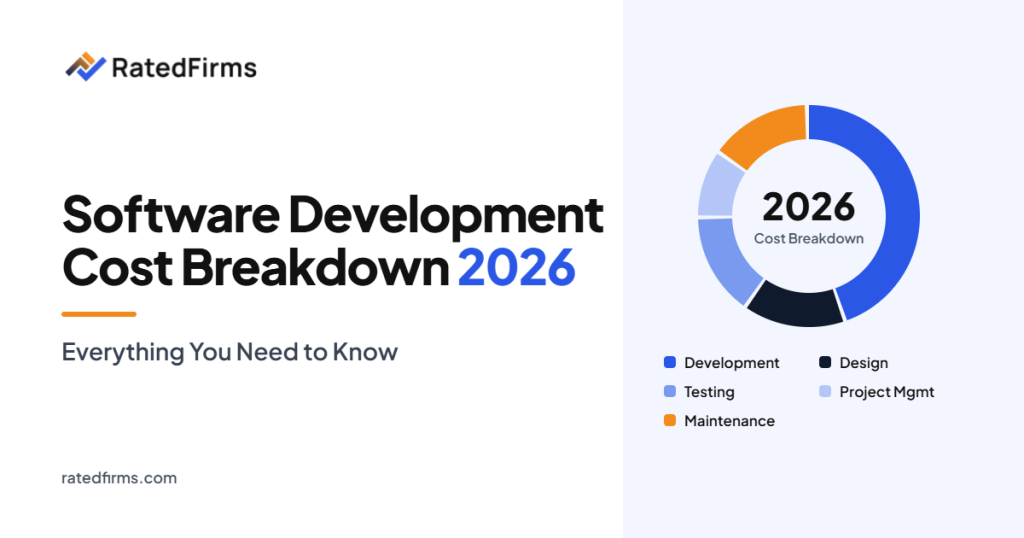
Software development cost in 2026 can range from around $17,500 for a small MVP to several million dollars for complex enterprise applications. Most mid-sized custom software projects fall between $50,000 and $400,000, depending on their features, technical complexity, development team, and location.
But what actually determines the final price?
Two major factors shape your development budget: the number of hours required to complete the project and the hourly rate of the development team. Other expenses, including UI/UX design, testing, third-party integrations, hosting, security, and ongoing maintenance, also affect the total investment.
This guide breaks down software development cost by project type, development stage, country, and pricing model. You’ll also find practical cost estimates, developer hourly rate comparisons, a worked budget example, and actionable ways to manage development expenses in 2026.
Whether you’re planning an MVP, a custom web application, a mobile app, or an enterprise platform, this guide will help you understand what goes into your software development budget.
How Much Does Software Development Cost in 2026?
Average Software Development Cost in 2026
Software development cost typically range from $17,500 to several million dollars in 2026. A small MVP or internal application may require a relatively modest investment, while enterprise platforms with complex integrations, security requirements, and multiple modules can cost substantially more.
The actual cost depends on the project’s scope, the number of development hours, the team’s hourly rates, and additional expenses.
For example, the same application could cost $70,000 with an offshore team and $300,000 with a higher-priced onshore agency. The difference comes from labor rates, team structure, and project delivery costs rather than necessarily from the software’s features.
A useful starting point is:
Software Development Cost = Total Development Hours × Blended Hourly Rate + Additional Expenses
Here are the main factors that determine the final cost:
- Project complexity: Applications with advanced workflows, multiple user roles, and complex business logic require more development hours.
- Features and functionality: Payments, real-time messaging, analytics, and third-party integrations increase development effort.
- Development team location: Hourly rates vary significantly across countries and regions.
- Technology stack: Specialized technologies and infrastructure can increase development and maintenance expenses.
- Security requirements: Applications handling financial, personal, or healthcare data may need additional security controls and compliance work.
- Project timeline: Tight deadlines can require additional developers or parallel work, increasing the budget.
Software Development Cost at a Glance
The following table provides illustrative software development cost estimates for 2026. It uses three blended hourly-rate assumptions:
- Offshore: $35/hour
- Nearshore: $60/hour
- Onshore agency: $150/hour
These are planning scenarios, not fixed market averages. Actual vendor rates vary by country, seniority, specialization, and delivery model.
| Software project type | Estimated hours | Offshore ($35/hr) | Nearshore ($60/hr) | Onshore ($150/hr) | Timeline |
| MVP or simple internal tool | 500–1,200 | $17,500–$42,000 | $30,000–$72,000 | $75,000–$180,000 | 2–4 months |
| Custom web application | 1,200–3,000 | $42,000–$105,000 | $72,000–$180,000 | $180,000–$450,000 | 4–7 months |
| Cross-platform mobile app | 1,000–2,500 | $35,000–$87,500 | $60,000–$150,000 | $150,000–$375,000 | 3–6 months |
| SaaS platform | 2,500–6,000 | $87,500–$210,000 | $150,000–$360,000 | $375,000–$900,000 | 6–12 months |
| Enterprise software | 6,000–20,000 | $210,000–$700,000 | $360,000–$1.2M | $900,000–$3M | 9–24 months |
| AI-powered product features | 1,500–5,000 | $52,500–$175,000 | $90,000–$300,000 | $225,000–$750,000 | 4–9 months |
Note: These estimates represent illustrative development labor budgets based on the stated hours and rates. They exclude hosting, licenses, third-party services, taxes, and post-launch maintenance. Timelines assume suitable team availability and a reasonably defined scope.
Software Development Cost by Software Type
Different software products require different development resources. A simple internal application may need only a few core features, while a SaaS platform or enterprise system requires more complex architecture, integrations, and security controls.
Let’s look at the estimated cost of common software development projects.
Custom Software Development Cost
Custom software development typically costs between $17,500 and $700,000 or more, depending on the application’s scope and complexity.
The price depends on the number of user roles, business workflows, integrations, and technical requirements.
For example, a basic employee scheduling application for one department may need 500–800 development hours. However, adding role-based permissions, payroll integration, reporting, and audit logs can significantly increase the workload.
The main cost factors include:
- Custom business logic and workflows
- User authentication and access permissions
- Database architecture
- Third-party integrations
- Reporting and analytics
- Security and scalability requirements
One important consideration is that integrations and permissions can require more effort than the visible screens of an application. Businesses should account for backend functionality when estimating custom software development cost.
Web Application Development Cost
A custom web application typically requires 1,200–3,000 development hours, resulting in an estimated development cost of $42,000–$450,000 across the pricing scenarios used in this guide.
Common examples include:
- Customer portals
- Booking and appointment systems
- Business dashboards
- Inventory management platforms
- Online marketplaces
- Project management applications
A typical web application includes a responsive frontend, backend APIs, database, authentication, and an administrative dashboard.
Costs increase when the application requires real-time updates, advanced reporting, complex user permissions, or multiple third-party integrations.
For example, a customer portal with order tracking, payment processing, invoice downloads, and an admin dashboard requires more backend development than a basic informational website.
When estimating a web application budget, include both customer-facing functionality and administrative features.
Mobile App Development Cost
Mobile app development typically costs between $35,000 and $375,000 for a cross-platform application under the pricing assumptions used in this guide.
The final price depends on whether you build a native application for iOS and Android or use a cross-platform framework such as Flutter or React Native.
Common mobile app development requirements include:
- User registration and authentication
- Push notifications
- Payment integration
- GPS and location tracking
- Offline functionality
- Real-time messaging
- Backend APIs and databases
Cross-platform development can reduce duplicated implementation work because developers can share much of the code between platforms.
However, complex device-specific functionality may still require native development.
You should also account for app store requirements, device testing, security, and backend infrastructure when estimating the total cost.
SaaS Development Cost
SaaS development typically costs between $87,500 and $900,000 for an initial product release, depending on its features and technical complexity.
Unlike a basic single-user application, SaaS software must support multiple customers through a shared platform.
Common SaaS requirements include:
- Multi-tenant architecture
- Subscription and payment management
- User authentication
- Role-based access control
- Customer onboarding
- Usage tracking
- Analytics and reporting
- Data security and backups
For example, a SaaS project management platform needs more than task creation and user registration. It may also require team workspaces, subscription plans, permissions, notifications, and billing management.
SaaS products also require ongoing investment after launch because businesses continuously improve features, maintain infrastructure, and support customers.
Enterprise Software Development Cost
Enterprise software development can cost from several hundred thousand dollars to several million dollars.
These applications support complex business operations and often connect multiple departments, databases, and existing systems.
Examples include:
- Enterprise resource planning (ERP) systems
- Customer relationship management (CRM) platforms
- Supply chain management systems
- Banking and financial applications
- Healthcare management platforms
- Enterprise data management systems
The major cost drivers include:
- Legacy system integration
- Large-scale data migration
- Complex workflows
- Advanced user permissions
- Regulatory and security requirements
- Performance and scalability
- Multi-department implementation
Enterprise projects also carry higher budget risks because requirements can change during implementation.
Research by McKinsey and the University of Oxford covering more than 5,400 IT projects found that large projects had substantial cost and schedule overruns. This makes careful planning, governance, and realistic contingency budgets especially important for enterprise software.
AI Software Development Cost
AI-powered software development typically costs more than conventional applications because it may require specialized engineering, data preparation, model integration, testing, and monitoring.
Adding AI-powered features to an existing application may require approximately 1,500–5,000 hours for a substantial implementation, depending on the scope.
Examples include:
- AI-powered customer support assistants
- Intelligent document processing
- Recommendation engines
- Predictive analytics
- Natural language search
- Automated content analysis
The cost depends on whether you integrate an existing AI model or build and train a custom model.
Using a third-party model API can reduce initial development expenses. However, businesses must account for usage-based API charges, data security, evaluation, and ongoing monitoring.
Custom model development generally requires additional data science, machine learning, and infrastructure resources.
Software Development Cost Comparison by Type
| Software type | Main cost drivers | Estimated hours | Typical timeline |
| Custom internal software | User roles, integrations, workflows | 500–2,000 | 2–6 months |
| Web application | Admin panel, reporting, real-time features | 1,200–3,000 | 4–7 months |
| Mobile application | Offline mode, payments, device features | 1,000–2,500 | 3–6 months |
| SaaS platform | Multi-tenancy, billing, security | 2,500–6,000 | 6–12 months |
| Enterprise software | Data migration, legacy integrations, compliance | 6,000–20,000+ | 9–24 months |
| AI-powered software | Data preparation, model integration, evaluation | 1,500–5,000 | 4–9 months |
All ranges are illustrative planning estimates, not guaranteed quotations. The actual scope and delivery approach can change the required hours.
Software Development Cost Breakdown by Project Stage
Software development involves several stages, and each contributes to the overall project budget.
A development estimate should account for planning, design, frontend and backend development, testing, deployment, and project management.
The following allocation represents one illustrative budget for a mid-sized custom web or mobile application.
| Development stage | Example budget allocation | Main activities |
| Planning and requirement analysis | 8% | Workshops, requirements, architecture |
| UI/UX design | 12% | Wireframes, user flows, prototypes |
| Frontend and backend development | 48% | Interfaces, APIs, database, integrations |
| Testing and quality assurance | 18% | Functional, security, and performance testing |
| Deployment and launch | 4% | Infrastructure, CI/CD, release |
| Project management | 10% | Planning, coordination, reporting |
| Total | 100% |
These percentages are illustrative. Actual allocations vary with project complexity, compliance requirements, team structure, and delivery methodology. Project management is shown separately to avoid double-counting it across development stages.
Planning and Requirement Analysis
Planning and requirement analysis establish the foundation of a software project.
During this stage, the team identifies business objectives, defines the project scope, documents requirements, and creates the technical architecture.
Typical activities include:
- Stakeholder discussions
- Requirement gathering
- User story creation
- Technical feasibility analysis
- Database and system architecture planning
- Initial cost and timeline estimation
A well-planned discovery phase helps identify potential problems before development begins.
For example, identifying a required ERP integration during planning is much cheaper than discovering it after the backend has already been developed.
UI/UX Design and Prototyping
UI/UX design determines how users interact with the software.
This stage includes user flows, wireframes, visual design, interactive prototypes, and design systems.
The cost depends on the number of screens, user roles, design complexity, and accessibility requirements.
A clickable prototype also allows stakeholders to review the experience before developers begin implementation.
Making design changes during this stage is generally less expensive than changing completed functionality.
Frontend and Backend Development
Frontend and backend development usually account for the largest portion of the software development budget.
Frontend development focuses on the user interface, while backend development handles business logic, databases, APIs, authentication, and integrations.
For example, an e-commerce application may require:
- Product listing and search
- Shopping cart functionality
- Payment processing
- Order management
- User accounts
- Inventory synchronization
- Administrative dashboards
Backend functionality can require more development effort than users see on the screen, particularly when an application includes complex business rules or multiple integrations.
Testing and Quality Assurance
Testing and quality assurance help ensure that software works as expected before and after launch.
Common testing activities include:
- Functional testing
- Integration testing
- Regression testing
- Performance testing
- Security testing
- Cross-browser and device testing
- User acceptance testing
Testing should happen throughout development rather than only at the end.
For applications handling sensitive information or financial transactions, security and performance testing become especially important.
Reducing QA effort may lower the initial quote, but it can increase the risk of defects, rework, and expensive production issues.
Deployment and Launch
Deployment prepares the application for real-world use.
Typical activities include:
- Production environment setup
- Database configuration
- CI/CD pipeline implementation
- Domain and server configuration
- Monitoring setup
- Application release
- Final documentation and handover
Although deployment represents a relatively small portion of many development budgets, it is essential for a reliable launch.
After deployment, recurring expenses such as hosting, monitoring, and maintenance begin.
Software Developer Hourly Rates by Country in 2026
Software developer hourly rates vary according to location, experience, specialization, and engagement model.
Before comparing rates, it is important to distinguish between two different figures:
Employee wages: The amount a developer earns from an employer.
Vendor billing rates: The amount a software development company charges a client.
Vendor rates include more than developer salaries. They may cover employee benefits, management, infrastructure, recruitment, non-billable time, quality assurance, and profit margins.
Software Developer Rates in the USA
The US Bureau of Labor Statistics reported a median annual wage of $135,980 for software developers in May 2025. This equals approximately $65.38 per hour when calculated using 2,080 working hours annually.
This figure represents employee wages, not the hourly price charged by an agency.
US development agencies generally charge more because their rates also account for operating expenses, project management, benefits, and business margins.
For budgeting purposes, this guide uses $150 per hour as an illustrative onshore agency billing assumption. Actual quotes can be lower or higher depending on the project and team.
Software Developer Rates in the UK
UK developer wages vary by experience, location, and specialization.
London and other major technology markets generally have higher salary and operating costs than smaller regional markets.
When comparing UK development costs, distinguish between employee salaries, independent contractor rates, and agency billing rates.
The Office for National Statistics’ Annual Survey of Hours and Earnings provides a useful reference for UK occupational pay. However, employee wage statistics should not be treated as direct agency pricing.
Software Developer Rates in India
India remains an important software development market because it offers a large technology workforce across multiple experience levels and specializations.
Development costs vary according to:
- Developer experience
- Technology specialization
- Project complexity
- Team structure
- Vendor location
- Quality assurance and management requirements
For planning purposes, this guide uses $35 per hour as an illustrative offshore blended rate. It is not a fixed or universal Indian developer rate.
Some vendors charge less, while experienced specialists and established delivery teams may charge substantially more.
Software Developer Rates in Canada
According to Canada’s Job Bank, the national median wage for software developers and programmers (NOC 21232) was C$48.08 per hour in its November 19, 2025 update.
The published range was:
- Low: C$30.00 per hour
- Median: C$48.08 per hour
- High: C$76.92 per hour
These figures represent employee wages, not software development agency rates.
Canadian development costs also vary across provinces and major technology markets.
Software Developer Rates in Australia
Australian developer salaries vary by city, specialization, and professional experience.
Sydney and Melbourne have large technology markets, while other regions may offer different salary and operating-cost structures.
When estimating Australian software development cost, consider whether the quote comes from an individual contractor, an in-house team, or an agency.
Do not compare annual employee earnings directly with agency hourly billing rates.
Software Developer Rates in Europe
Europe has several distinct software development markets.
Western European markets generally have higher operating and labor costs, while Central and Eastern European markets can offer different pricing structures.
The right comparison depends on the specific country, seniority, technology stack, and team composition.
Software Development Hourly Rate Comparison
The following figures illustrate selected wage and outsourcing benchmarks. They are not a directly comparable country-by-country agency rate card.
| Market | Available benchmark | What it represents |
| USA | $65.38/hour | Median employee wage, May 2025 |
| Canada | C$48.08/hour | Median employee wage, November 2025 update |
| Asia | $35/hour | Senior developer median in Accelerance’s 2026 survey |
| Eastern Europe | $65/hour | Senior developer median in Accelerance’s 2026 survey |
| Latin America | $58/hour | Senior developer median in Accelerance’s 2026 survey |
| Global | $60/hour | Senior developer median in Accelerance’s 2026 survey |
The regional vendor benchmarks come from Accelerance’s November 6, 2026 report based on a survey of 50 software engineering partners. Employee wage figures come from government labor statistics. These measures have different methodologies and should not be interpreted as equivalent prices.
The latest Accelerance report also identifies higher median rates for specialist roles:
- Senior full-stack developers: $61/hour globally
- Senior DevOps specialists: $65/hour globally
- Software architects: $75/hour globally
- AI engineering roles: $75/hour globally
This illustrates an important pricing trend: specialized engineering capabilities can command a premium even when general development rates remain relatively stable.
Key Factors Affecting Software Development Cost
Several technical and business factors determine how much a software project costs.
Understanding these factors helps businesses prepare more realistic budgets and avoid unexpected expenses.
Project Size and Complexity
Project size directly affects the number of development hours required.
A simple application with a few screens and basic functionality requires fewer resources than a platform with multiple user roles, advanced workflows, and third-party integrations.
Complexity also increases when different modules depend on each other.
For example, a basic payment feature may require less effort than a complete payment system supporting refunds, partial payments, multiple currencies, fraud checks, and transaction reporting.
Features and Functionalities
The number and complexity of features influence development time and cost.
Some features require more specialized development than others.
Examples include:
- Real-time messaging
- Advanced search
- Payment processing
- Offline functionality
- GPS tracking
- Automated reporting
- Role-based permissions
- AI-powered recommendations
Businesses can manage costs by prioritizing essential functionality and postponing lower-priority features until later releases.
Technology Stack
The technology stack includes the programming languages, frameworks, databases, and infrastructure used to build software.
Common technologies include React, Angular, Node.js, Python, Java, .NET, Flutter, and React Native.
A mainstream technology stack often provides access to a larger talent pool and established development tools.
Specialized or legacy technologies may require experienced developers who charge higher rates.
The technology stack also affects long-term infrastructure, maintenance, and scalability expenses.
Developer Experience and Team Size
Developer experience influences both hourly rates and project efficiency.
Senior developers typically charge more than junior developers, but they can also handle complex tasks, make architectural decisions, and identify technical problems earlier.
Team size also affects the overall budget.
A larger team may speed up delivery when tasks can run in parallel. However, adding more developers also increases coordination and management requirements.
The right team size depends on project scope, deadlines, and technical complexity.
UI/UX Design Requirements
Design requirements affect both the time and resources needed to complete a project.
A basic application using standard components may require less design work than a product with custom illustrations, animations, interactive dashboards, and complex user journeys.
Accessibility requirements can also increase design and testing effort.
Investing in clear and consistent UI/UX design can improve usability and reduce expensive redesigns later.
Third-Party Integrations and Security Requirements
Integrations connect software with external platforms, services, and databases.
Common examples include:
- Payment gateways
- CRM platforms
- ERP systems
- Email and SMS services
- Mapping APIs
- Identity verification tools
- Analytics platforms
Each integration may require authentication, data mapping, error handling, testing, and ongoing maintenance.
Security requirements also influence development costs.
Applications handling healthcare, financial, or personal data may require encryption, audit logs, access controls, penetration testing, and regulatory compliance measures.
For example, a healthcare application handling sensitive patient information needs stronger data protection and access management than a basic internal task management tool.
The additional cost depends on the applicable regulations, system architecture, and security scope.
Software Development Pricing Models
Software development companies use different pricing models depending on project scope, duration, and flexibility requirements.
The most common models include fixed-price, hourly, time and materials, and dedicated development teams.
Fixed-Price Model
Under a fixed-price model, the client and development provider agree on a total project cost before development begins.
This model works well when requirements, deliverables, and deadlines are clearly defined.
Advantages:
- Predictable initial budget
- Clearly defined deliverables
- Easier financial planning
Limitations:
- Changes may require additional payments.
- Providers may include a risk premium.
- Flexible requirements can create disputes.
Fixed pricing is generally more suitable for smaller projects with stable requirements.
Hourly Pricing Model
Under hourly pricing, the client pays for the actual development hours worked.
For example, if a developer charges $50 per hour and completes 100 hours of work, the development cost is $5,000.
Advantages:
- Flexible work arrangements
- Suitable for ongoing improvements
- Easy to adjust priorities
Limitations:
- Total spending can increase.
- Project duration may vary.
- Requires regular progress tracking.
This model works well for maintenance, small tasks, and projects with changing requirements.
Time and Materials Model
The time and materials model charges clients for actual working hours and approved project expenses.
Unlike a strict fixed-price arrangement, it allows the project scope to evolve as requirements become clearer.
Advantages:
- Flexible development process
- Supports iterative delivery
- Suitable for changing requirements
Limitations:
- Requires active budget monitoring.
- Final costs may differ from initial estimates.
- Needs clear reporting and prioritization.
This model is common in agile software development projects.
Dedicated Development Team Model
Under a dedicated team model, a business pays a monthly fee for a team assigned to its project.
The team may include software developers, QA engineers, designers, DevOps specialists, and project managers.
Advantages:
- Long-term team continuity
- Predictable monthly expenses
- Access to different technical skills
Limitations:
- Requires ongoing management.
- Monthly costs continue during the engagement.
- Productivity depends on effective planning.
This model works well for long-term software products and businesses that need continuous development capacity.
Software Development Pricing Model Comparison
| Pricing model | Payment structure | Main advantage | Main limitation | Best suited for |
| Fixed price | Agreed project amount | Budget predictability | Costly scope changes | Clearly defined projects |
| Hourly | Hours × hourly rate | Flexibility | Spending can increase | Maintenance and small tasks |
| Time and materials | Actual hours and expenses | Adapts to changing scope | Needs budget monitoring | Agile product development |
| Dedicated team | Monthly team fee | Continuity | Ongoing monthly commitment | Long-term projects |
Hidden Costs of Software Development
The initial development quote does not always represent the total cost of owning software.
Businesses also need to account for additional expenses that arise during development and after launch.
These expenses may be one-time or recurring.
| Cost category | Expense type | Examples |
| Software licenses and tools | Recurring | Development tools, design software, testing tools |
| Cloud hosting and infrastructure | Recurring | Servers, databases, storage, backups |
| Security and compliance | Both | Penetration testing, audits, certifications |
| APIs and third-party services | Recurring | Payment, email, SMS, mapping, AI services |
| Maintenance and updates | Recurring | Bug fixes, upgrades, performance improvements |
Software Licensing and Third-Party Tools
Development teams use different software tools throughout the development process.
These may include:
- Code repositories
- Project management platforms
- Design applications
- Automated testing tools
- Monitoring services
- AI coding assistants
Some tools charge monthly or annual subscription fees based on the number of users.
Before finalizing a development budget, confirm whether these expenses are included in the vendor’s pricing or billed separately.
Cloud Hosting and Infrastructure
Cloud infrastructure supports the software after deployment.
Common expenses include:
- Application servers
- Database hosting
- File storage
- Content delivery networks
- Backups
- Monitoring
- Bandwidth
A small application may operate on a relatively modest hosting budget, while a high-traffic platform with large datasets and real-time functionality can require substantially more infrastructure spending.
Ask for infrastructure estimates based on expected usage at launch and as the application grows.
Security and Compliance
Security expenses can include penetration testing, vulnerability assessments, encryption, monitoring, and compliance audits.
Applications operating in regulated industries may also require specialized security controls and documentation.
These expenses can occur before launch and continue throughout the software’s lifecycle.
Businesses should identify applicable security and compliance requirements during project planning rather than treating them as last-minute additions.
API and Third-Party Service Costs
Many applications depend on external APIs and services.
Examples include:
- Payment processing
- SMS notifications
- Email delivery
- Maps and location services
- Identity verification
- AI model APIs
Providers often charge according to usage, such as the number of API requests, messages, transactions, or processed tokens.
These expenses can increase as the number of users grows.
Estimate usage costs based on expected monthly activity rather than assuming every API will remain inexpensive.
Ongoing Maintenance and Updates
Software requires continuous maintenance after launch.
Developers may need to fix bugs, update dependencies, improve performance, patch security vulnerabilities, and maintain compatibility with newer operating systems and browsers.
Maintenance should be included in the long-term software budget, even when the application does not receive major new features.
How to Estimate Software Development Cost
Estimating software development cost requires a clear understanding of project scope, required development hours, team rates, and additional expenses.
A structured estimation process helps businesses prepare realistic budgets before development begins.
Software Development Cost Estimation Formula
The basic software development cost formula is:
Estimated Development Cost = Total Development Hours × Blended Hourly Rate + Additional Expenses
Where:
- Total Development Hours: The combined hours required for planning, design, development, testing, deployment, and project management.
- Blended Hourly Rate: The average hourly cost across the project team.
- Additional Expenses: Hosting, licenses, APIs, security testing, and other non-labor costs.
For example, a project requiring 2,000 development hours at a blended rate of $60 per hour will have a labor cost of $120,000.
Additional expenses must be added to calculate the complete project budget.
Step-by-Step Cost Calculation
Follow these steps to estimate your software development budget.
Step 1: Define the project scope
List the main features, user roles, workflows, integrations, and platforms required.
Step 2: Divide the project into modules
Break the application into smaller components, such as authentication, dashboards, payment processing, reporting, and administration.
Step 3: Estimate development hours
Calculate the hours required for each module and development activity.
Include design, frontend, backend, testing, deployment, and project management.
Step 4: Determine the blended hourly rate
Calculate the average hourly cost of the complete team rather than using only one developer’s rate.
Step 5: Add additional expenses
Include software licenses, hosting, APIs, security testing, and other project-related expenses.
Step 6: Add a contingency reserve
A contingency of 10–20% can be a reasonable starting assumption for a reasonably defined project. Projects with uncertain requirements or complex integrations may need a larger reserve.
Step 7: Estimate post-launch expenses
Calculate expected hosting, maintenance, support, and third-party service costs separately.
Example of a Software Development Budget
Consider a B2B customer portal that allows customers to log in, view orders and invoices, raise support tickets, and download documents.
The application also includes an administrative dashboard and integrations with an ERP system and a payment gateway.
The following example uses an assumed blended rate of $60 per hour.
| Development activity | Estimated hours | Cost |
| Planning and discovery | 120 | $7,200 |
| UI/UX design | 240 | $14,400 |
| Frontend development | 520 | $31,200 |
| Backend development and integrations | 620 | $37,200 |
| Testing and QA | 300 | $18,000 |
| Deployment and DevOps | 80 | $4,800 |
| Project management | 200 | $12,000 |
| Total labor | 2,080 | $124,800 |
Additional first-year expenses:
| Additional expense | Assumption | Estimated cost |
| Cloud hosting | $400/month | $4,800 |
| Email, monitoring, and other services | $200/month | $2,400 |
| Penetration testing | One-time estimate | $8,000 |
| Contingency | 15% of labor | $18,720 |
| Additional expenses | $33,920 |
Estimated first-year project budget: $158,720
This example shows how quickly additional expenses can increase the total investment beyond the initial development quote.
The same 2,080 labor hours would cost:
- At $35/hour: $72,800
- At $60/hour: $124,800
- At $150/hour: $312,000
These figures show how the hourly rate affects the labor budget. They do not imply that every team will deliver identical results or require exactly the same number of hours.
Software Development Cost by Project Size
Software project size influences the development team, timeline, technical requirements, and overall budget.
For budgeting purposes, projects can be grouped into small, medium-sized, and large or enterprise categories.
Small Software Projects
Small software projects typically require around 500–1,200 development hours.
Examples include:
- Internal approval applications
- Simple booking systems
- Basic inventory tools
- Small business dashboards
- MVP applications
- Proof-of-concept products
These projects usually involve a limited number of features, user roles, and integrations.
Under the pricing assumptions used in this guide, a small project may cost:
- Offshore: $17,500–$42,000
- Nearshore: $30,000–$72,000
- Onshore: $75,000–$180,000
The typical development timeline is around two to four months.
Medium-Sized Software Projects
Medium-sized projects typically require around 1,200–6,000 development hours.
Examples include:
- Customer portals
- Cross-platform mobile applications
- Business management systems
- First-release SaaS platforms
- E-commerce applications
These projects generally require a larger team and more complex backend functionality.
Development costs may range from approximately $42,000 to $900,000 under the three pricing scenarios used in this guide.
The timeline can range from four to twelve months.
Large and Enterprise Software Projects
Large software projects typically require 6,000–20,000 or more development hours.
Examples include:
- Enterprise resource planning systems
- Large supply chain platforms
- Banking applications
- Healthcare information systems
- Multi-department business platforms
These projects often require architects, backend specialists, frontend developers, QA engineers, DevOps professionals, and project managers.
Complex integrations, data migration, security controls, and regulatory requirements can significantly increase the budget.
Depending on team location and scope, costs can reach several million dollars.
Development may take nine months to two years or longer.
MVP vs. Full-Scale Software Development Cost
An MVP and a full-scale software product have different development requirements.
An MVP focuses on essential functionality, while a full-scale product includes additional features, integrations, and infrastructure needed to support a broader user base.
MVP Development Cost
A Minimum Viable Product (MVP) is an early version of a product that includes enough functionality to solve a core user problem and collect feedback from real users.
An MVP may require approximately 500–1,200 development hours, depending on the product.
Using this guide’s pricing assumptions:
- Offshore: $17,500–$42,000
- Nearshore: $30,000–$72,000
- Onshore: $75,000–$180,000
Typical MVP features include:
- User registration
- Core product functionality
- Basic dashboard
- Essential database functionality
- Basic reporting
- Required integrations
The purpose of an MVP is to validate the product’s value before investing in a larger feature set.
Full-Scale Product Development Cost
A full-scale software product includes more comprehensive functionality and infrastructure.
It may require 3,000–8,000 or more development hours, depending on its scope.
Additional features may include:
- Advanced user management
- Multiple payment options
- Detailed analytics
- Third-party integrations
- Automated workflows
- Advanced security
- Scalable infrastructure
- Multi-platform support
Under the pricing assumptions used in this guide, development costs may range from approximately $105,000 to $1.2 million or more.
Key Cost Differences Between MVP and Full-Scale Development
| Factor | MVP | Full-scale product |
| Features | Core functionality | Comprehensive feature set |
| Platforms | Usually one | Multiple platforms may be required |
| Development hours | 500–1,200 | 3,000–8,000+ |
| Offshore budget | $17,500–$42,000 | $105,000–$280,000+ |
| Onshore budget | $75,000–$180,000 | $450,000–$1.2M+ |
| Timeline | 2–4 months | 6–18 months |
| Technical requirements | Essential security and infrastructure | Advanced scalability, monitoring, and integrations |
An MVP can reduce the initial investment, but it still needs a sound technical foundation. Poor architecture or inadequate security can make future expansion more expensive.
In-House vs. Outsourced Software Development Cost
Businesses can develop software using an internal team or an external development provider.
Both approaches have different cost structures.
In-House Software Development Cost
An in-house development team consists of employees who work directly for the business.
The total cost includes more than employee salaries.
Typical expenses include:
- Developer salaries
- Employee benefits
- Recruitment and onboarding
- Hardware and software
- Office infrastructure
- Training
- Management and administration
For example, a US-based team of four software developers and one QA analyst can have a substantial annual employment cost before recruitment, equipment, software, and management expenses.
Using the May 2025 BLS median wages, four developers earning $135,980 each and one QA analyst earning $104,300 would have a combined annual wage cost of $647,?00.
More precisely:
4 × $135,980 + $104,300 = $648,220 in annual wages.
Employer benefits and other operating expenses would increase the total.
Outsourced Software Development Cost
Outsourcing allows businesses to access external development teams without directly employing every specialist.
The provider generally manages recruitment, employee compensation, equipment, and team administration within its commercial pricing.
For example, a five-person team working a combined 9,600 billable hours annually would cost:
- At $35/hour: $336,000
- At $60/hour: $576,000
- At $150/hour: $1,440,000
The actual cost depends on the number of billable hours, team composition, and contract terms.
Businesses still need internal product ownership, requirement management, and acceptance testing.
Cost Comparison: In-House vs. Outsourcing
| Cost factor | In-house team | Outsourced team |
| Employee salaries | Paid directly | Included in vendor pricing |
| Recruitment | Business responsibility | Generally managed by provider |
| Benefits | Paid by employer | Included in vendor pricing |
| Equipment | Business responsibility | Usually included |
| Project management | Internal management | Depends on contract |
| Team availability | Depends on recruitment | Depends on provider capacity |
| Knowledge retention | Internal employees | Requires documentation and handover planning |
In-house development can make sense for businesses that need permanent engineering capabilities and long-term product ownership.
Outsourcing can be useful when a business needs additional technical expertise, flexible capacity, or support for a defined project.
Some businesses combine both approaches by maintaining a small internal product team and using external specialists when needed.
Software Maintenance and Support Costs in 2026
Software development cost do not end when an application launches.
Every software product needs ongoing maintenance to remain secure, compatible, and reliable.
Annual Software Maintenance Costs
A common budgeting starting point is 15–20% of the original development cost per year for maintenance labor.
This is a planning assumption, not a universal industry rule. Actual costs may fall outside this range depending on the application’s complexity, service requirements, and release schedule.
For example, if an application costs $124,800 to develop:
- At 15%: $18,720 per year
- At 20%: $24,960 per year
These amounts cover estimated maintenance labor. Hosting, third-party subscriptions, and major feature development should be budgeted separately.
Bug Fixes and Performance Updates
Software may develop defects after launch as users interact with features in different ways.
Maintenance teams identify and resolve these problems through bug fixes and performance improvements.
Typical activities include:
- Error correction
- Database optimization
- Performance monitoring
- Browser compatibility updates
- Security patches
- Application stability improvements
Businesses should define support expectations clearly, including response times, severity levels, and included monthly maintenance hours.
Software Upgrades and Scalability Costs
As applications grow, their infrastructure and technical requirements change.
For example, an application supporting 500 users may need architectural or infrastructure improvements when it grows to 50,000 users.
Common upgrade requirements include:
- Database optimization
- Cloud infrastructure scaling
- Framework upgrades
- API updates
- Security improvements
- Code refactoring
- New functionality
Planning for these improvements helps businesses avoid expensive emergency upgrades and unexpected performance problems.
How AI Is Affecting Software Development Cost in 2026
Artificial intelligence is changing software development workflows, but its impact on total project costs depends on how businesses and development teams use it.
AI can support coding, testing, documentation, and analysis. However, software architecture, integration, security, and quality assurance still require careful engineering and human oversight.
AI-Assisted Software Development Cost
AI coding assistants can help developers generate code, explain technical concepts, write tests, and document existing applications.
The Stack Overflow 2025 Developer Survey found that 84% of respondents were using or planning to use AI tools in their development process.
However, 46% reported distrusting the accuracy of AI-generated output, compared with 33% who trusted it.
This shows why AI-generated code still needs review, testing, and validation.
AI tools may reduce the time required for certain repetitive tasks, but they do not automatically reduce the total cost of a software project.
The final budget still depends on requirements, architecture, integrations, testing, and delivery quality.
Custom AI Software Development Cost
Building custom AI-powered software requires additional technical resources.
Depending on the application, development may involve:
- Data collection and preparation
- Model selection
- Model integration
- Retrieval-augmented generation (RAG)
- Prompt engineering
- Evaluation and testing
- Security and privacy controls
- Performance monitoring
For example, a customer support application using an existing language model API may require less initial investment than a custom machine learning platform trained on proprietary datasets.
Custom AI development can also introduce infrastructure and specialist staffing expenses.
AI Integration Costs in Existing Software
Integrating AI into existing software can be less expensive than building an AI platform from scratch.
Common integration examples include:
- AI customer support assistants
- Document summarization
- Smart search
- Automated data extraction
- Recommendation features
- Natural language interfaces
Using an existing model API reduces the need to build and maintain a model infrastructure.
However, businesses should consider API usage fees, data privacy, output evaluation, caching, and ongoing monitoring.
AI model prices and usage limits can change, so estimate operating costs using current provider pricing before launch.
How to Reduce Software Development Cost
Businesses can reduce software development expenses through better planning, clear requirements, and efficient technical decisions.
The goal should be to control unnecessary spending without sacrificing software quality, security, or long-term performance.
Prioritize Essential Features
Not every feature needs to be included in the first release.
Identify the functionality that directly supports the application’s main purpose.
Prioritize features according to user value, business impact, and implementation effort.
Move optional functionality to future releases when possible.
Choose the Right Technology Stack
Select technologies that match the project’s requirements and have a reliable developer ecosystem.
Popular frameworks and programming languages can make it easier to find developers, maintain software, and access technical support.
Avoid selecting a technology simply because it is trending.
The right choice should support performance, security, scalability, and long-term maintenance.
Start with an MVP
An MVP allows businesses to launch essential functionality before investing in a complete product.
This approach helps validate assumptions, gather user feedback, and identify the features that deserve further investment.
However, keep the architecture secure and maintainable so the product can grow without requiring a complete rebuild.
Avoid Unnecessary Scope Changes
Frequent requirement changes can increase development time and create rework.
Maintain a clear project scope and establish a process for approving new features.
A prioritized backlog also helps development teams focus on the most important tasks.
Plan for Maintenance and Scalability
Consider long-term maintenance requirements during the initial development stage.
Include documentation, automated testing, security controls, and a clear handover process.
These activities may add to the initial budget, but they can reduce future maintenance effort and technical debt.
Conclusion
Software development cost in 2026 depend on project complexity, development hours, team location, technology requirements and ongoing operational expenses.
A small MVP may require a relatively modest investment, while complex SaaS and enterprise applications can cost hundreds of thousands or even millions of dollars.
Before setting a budget, consider the complete development lifecycle. Account for planning, design, development, testing, deployment, hosting, security, and annual maintenance. Compare estimates based on the same project scope rather than focusing only on hourly rates.
The most effective way to control software development cost is to define clear requirements, prioritize essential functionality, and plan for long-term maintenance from the beginning.
If you’re planning a software project, explore software development companies on RatedFirms to compare providers, hourly rates and minimum project budgets.
Frequently Asked Questions About Software Development Cost
What Is the Average Cost of Software Development in 2026?
Most mid-sized custom software projects can cost between $50,000 and $400,000 in 2026, depending on scope, complexity, and team rates. Small MVPs may start around $17,500 under the offshore pricing assumptions in this guide, while enterprise applications can cost several million dollars.
How Much Does Custom Software Development Cost?
Custom software development can cost approximately $17,500 for a small internal application to several hundred thousand dollars for complex business platforms. The final price depends on development hours, features, integrations, security requirements, and the team’s hourly rate.
How Much Do Software Developers Charge Per Hour?
Software developer rates vary by country, experience, and engagement model. The hourly rate charged by an agency is different from an employee’s hourly wage because agency pricing also covers management, infrastructure, benefits, and business expenses.
Is Software Development Cheaper in India?
India can offer lower development costs than many Western markets because of its large technology workforce and different operating-cost structure. However, rates vary by developer experience, specialization, vendor, and project complexity. Compare complete project estimates rather than hourly rates alone.
How Much Does It Cost to Build an MVP?
An MVP may require approximately 500–1,200 development hours. At the illustrative rates used in this guide, that equals $17,500–$42,000 offshore, $30,000–$72,000 nearshore, or $75,000–$180,000 onshore.
How Much Does Software Maintenance Cost?
A common starting budget is 15–20% of the original development cost annually for maintenance labor. Actual expenses depend on software complexity, integrations, security requirements, hosting, and the frequency of updates.
How Long Does It Take to Develop Custom Software?
A small MVP may take two to four months. Custom web and mobile applications often take three to seven months, while a first SaaS release may take six to twelve months. Complex enterprise projects can require nine months to two years or longer.
What Is the Cheapest Way to Develop Software?
Starting with an MVP, prioritizing essential features, and selecting an appropriate technology stack can reduce initial development costs. Existing software, low-code platforms, or third-party integrations may also be suitable when they meet the business requirements.