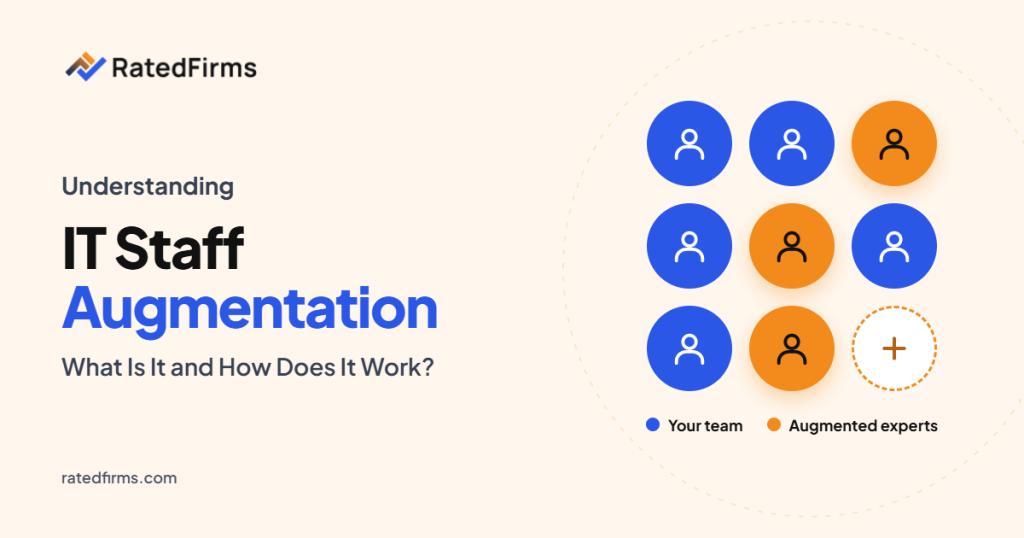
Businesses often need specialized IT skills to complete projects, manage workloads, and keep up with changing technology. However, hiring full-time employees can take time and increase operational costs. IT staff augmentation offers a flexible way to address these challenges.
IT staff augmentation allows businesses to hire external IT professionals who work alongside their in-house teams. Companies can add skilled developers, designers, QA engineers and other technical experts without making permanent hires.
This approach helps businesses fill skill gaps, reduce recruitment time, scale teams, and maintain control over their projects.
In this guide, you’ll learn what IT staff augmentation is, how it works, its different models, key benefits, costs, and challenges. You’ll also discover how to choose the right IT staff augmentation company for your business.
What Is IT Staff Augmentation?
IT staff augmentation is a hiring model that allows businesses to extend their existing IT teams by bringing in external professionals with specific technical skills. These professionals work directly with in-house employees and help businesses meet project requirements without hiring permanent staff.
Companies use staff augmentation to access specialized expertise, handle temporary workloads, and scale their teams based on business needs. For example, a company developing a mobile application can hire experienced app developers for the project without adding full-time employees.
IT Staff Augmentation Meaning
In simple terms, IT staff augmentation means adding skilled external professionals to your existing workforce when you need additional resources or technical expertise.
Rather than managing an entire project through a third-party provider, businesses work directly with augmented professionals and manage their daily tasks, responsibilities, and performance.
Staff Augmentation Definition and What It Means for Businesses
Staff augmentation is a flexible workforce strategy in which businesses hire external talent to fill specific skill gaps or support ongoing projects.
For businesses, this means:
- Access to expertise: Hire professionals with the technical skills your projects require.
- Workforce flexibility: Increase or reduce team size based on project demands.
- Lower hiring costs: Avoid expenses associated with permanent recruitment and long-term employment.
- Project control: Manage external professionals just like your in-house employees.
- Faster recruitment: Bring qualified professionals into your team without lengthy hiring processes.
This model allows businesses to focus on project goals while maintaining control over their teams and workflows.
How IT Staff Augmentation Differs from Traditional Hiring
Both staff augmentation and traditional hiring help businesses find skilled professionals, but they differ in flexibility, hiring commitments, and workforce management.
| IT Staff Augmentation | Traditional Hiring |
| Provides external professionals for specific needs | Adds permanent employees to the workforce |
| Usually involves shorter hiring timelines | Often requires lengthy recruitment |
| Offers flexible engagement periods | Typically involves long-term employment |
| Helps fill immediate skill gaps | Builds long-term internal capabilities |
| Reduces long-term employment commitments | Includes ongoing salary and employee benefits |
| Professionals work under the client’s direction | Employees work as part of the permanent team |
How Does IT Staff Augmentation Work?
IT staff augmentation follows a structured process that helps businesses find, hire, and integrate external IT professionals into their existing teams. From identifying skill requirements to managing performance, each step ensures the business gets the right talent for its project.
Here is how the process works:
1. Identify Your Business and Technical Requirements
Start by identifying your project goals, technical requirements, and skill gaps. Determine which roles you need, the experience level required, and how long you expect to need additional support. Clear requirements make it easier to find suitable professionals.
2. Choose the Right Staff Augmentation Company
Look for a staff augmentation company with experience in your industry and technology stack. Review its recruitment process, technical expertise, pricing, and client feedback. Choose a partner that understands your project requirements and can provide qualified professionals.
3. Select and Evaluate Qualified IT Professionals
Once you share your requirements, the provider searches for suitable candidates from its talent pool. Evaluate their technical skills, industry experience, communication abilities, and previous project work to ensure they match your expectations.
4. Interview and Finalize Candidates
Interview shortlisted candidates to assess their technical knowledge, problem-solving abilities, and compatibility with your team. Once you find the right professionals, finalize the selection, engagement terms, availability, and project responsibilities.
5. Onboard and Integrate Augmented Staff
Introduce selected professionals to your team, project goals, tools, workflows, and communication channels. Provide access to the resources they need and clearly explain their roles and responsibilities to ensure a smooth start.
6. Manage, Monitor, and Evaluate Performance
Manage augmented professionals as part of your existing team. Set clear expectations, assign tasks, track progress, and conduct regular performance reviews. Maintain consistent communication to address challenges and keep projects on schedule.
7. Scale or End the Engagement When Needed
As project requirements change, you can add more professionals, adjust team size, or extend existing engagements. Once the project ends or additional support is no longer necessary, you can conclude the engagement according to the agreed contract terms.
Different Types of IT Staff Augmentation Models
Not every business needs external IT professionals for the same duration or purpose. Some companies need temporary support, while others require dedicated experts for ongoing projects. IT staff augmentation offers several models to meet different business and technical requirements.
1. Short-Term Staff Augmentation
Short-term staff augmentation allows businesses to hire IT professionals for a limited period. Companies use this model to manage temporary workloads, fill immediate skill gaps, or complete urgent tasks without making permanent hires.
Best for: Temporary projects, urgent deadlines, and short-term resource requirements.
2. Long-Term Staff Augmentation
Long-term staff augmentation involves hiring external IT professionals for several months or longer. These professionals work closely with in-house teams and contribute to ongoing development, maintenance, and business operations.
Best for: Continuous development, long-term projects, and ongoing technical support.
3. Project-Based Staff Augmentation
Project-based staff augmentation focuses on hiring professionals with the skills required for a specific project. Businesses can build a dedicated team to complete project tasks without expanding their permanent workforce.
Best for: Software development, application upgrades, product launches, and digital transformation projects.
4. Skill-Based Staff Augmentation
This model helps businesses access specialized technical expertise that may be missing from their existing teams. Companies can hire professionals based on specific skills, technologies, or industry experience.
For example, businesses may hire cloud engineers, cybersecurity specialists, AI developers, or data scientists to handle specialized technical requirements.
Best for: Specialized technologies, technical skill gaps, and complex IT projects.
5. Onshore, Nearshore, and Offshore Staff Augmentation
Businesses can also choose staff augmentation based on where external professionals are located.
– Onshore Staff Augmentation: Hiring IT professionals from the same country as your business. This model supports easier communication, similar working hours, and smoother collaboration.
– Nearshore Staff Augmentation: Hiring professionals from nearby countries with similar time zones. It offers a balance between cost efficiency and convenient communication.
– Offshore Staff Augmentation: Hiring IT professionals from distant countries. This model provides access to global talent pools and potentially lower hiring costs.
What IT Staff Augmentation Services Do Companies Provide?
IT staff augmentation companies provide access to professionals across different technical fields. Businesses can hire individuals based on their project requirements, technology stack, and skill gaps. These services cover everything from software development and design to testing, cloud infrastructure, and project management.
Here are some common IT staff augmentation services companies offer:
1. Software Developers and Engineers
Companies provide experienced software developers and engineers to build, maintain, and improve software applications. They work with technologies such as Java, Python, .NET, PHP, and JavaScript to develop solutions that meet business requirements.
2. Web and Mobile App Developers
Businesses can hire web and mobile app developers to create responsive websites, web applications, and mobile solutions. These professionals work with technologies such as React, Angular, Flutter, React Native, and Swift.
3. UI/UX Designers
UI/UX designers help businesses create user-friendly and visually appealing digital products. They handle user research, wireframing, prototyping, interface design, and usability improvements to deliver better user experiences.
4. QA and Software Testing Engineers
QA engineers ensure software applications work correctly before release. They perform manual and automated testing, identify bugs, verify functionality, and help maintain software quality and performance.
5. DevOps and Cloud Engineers
DevOps and cloud engineers manage cloud infrastructure, deployment processes, and development environments. They help businesses automate workflows, improve system reliability, and manage platforms such as AWS, Microsoft Azure, and Google Cloud.
6. Data Scientists and Data Engineers
Data professionals help businesses collect, process, analyze, and interpret large amounts of information. Data engineers build data pipelines, while data scientists use analytics and machine learning to identify patterns and support business decisions.
7. Cybersecurity Specialists
Cybersecurity specialists protect business applications, networks, and systems from security threats. They help identify vulnerabilities, implement security measures, monitor potential risks, and support data protection and compliance requirements.
8. IT Project Managers and Business Analysts
IT project managers oversee project planning, resource allocation, timelines, and team coordination. Business analysts gather requirements, analyze business processes, and translate business needs into clear technical specifications.
Key Benefits of IT Staff Augmentation
IT staff augmentation helps businesses build stronger technical teams without the time and expense of traditional hiring. It provides access to skilled professionals, supports changing project demands, and gives companies more flexibility in managing their workforce.
Here are the major benefits of IT staff augmentation:
1. Access to Specialized IT Skills and Expertise
Finding professionals with specific technical skills can be challenging. Staff augmentation gives businesses access to experienced developers, cloud engineers, cybersecurity specialists, data scientists, and other IT experts. Companies can bring in the expertise they need without investing in lengthy recruitment or employee training.
2. Reduced Recruitment and Operational Costs
Hiring permanent employees involves recruitment expenses, salaries, benefits, training, and other overhead costs. Staff augmentation helps reduce these expenses by allowing businesses to hire professionals only when required. This makes workforce management more cost-effective.
3. Faster Hiring and Project Delivery
Traditional recruitment can delay project timelines. Staff augmentation companies maintain talent networks and recruitment processes that help businesses find qualified professionals faster. With the right experts available, teams can start projects sooner and meet important deadlines.
4. Flexible Workforce Scaling
Project requirements can change over time. Staff augmentation allows businesses to increase their team size when workloads grow and reduce resources when additional support is no longer needed. This flexibility helps companies manage resources according to their current priorities.
5. Greater Control Over Projects and Teams
Unlike traditional outsourcing, staff augmentation allows businesses to manage external professionals directly. Companies can assign tasks, set deadlines, monitor progress, and make project decisions while maintaining control over daily operations.
6. Improved Business Productivity
Adding experienced professionals helps existing teams distribute workloads more effectively. In-house employees can focus on their core responsibilities while augmented staff handle specific technical tasks. This improves collaboration, reduces workload pressure, and helps businesses maintain project momentum.
When Should Your Business Consider Staff Augmentation?
Staff augmentation is useful when your existing IT team cannot meet current business or project demands. Whether you need specialized skills, additional development support, or faster project execution, hiring external professionals can help you address these requirements without committing to permanent employees.
Here are some situations when businesses should consider IT staff augmentation:
1. Filling Technical Skill Gaps
If your in-house team lacks expertise in a particular technology, staff augmentation can help you find professionals with the required skills. For example, you can hire AI developers, cloud engineers, or cybersecurity specialists to handle specific technical requirements without investing in permanent recruitment.
2. Managing Increasing Project Workloads
When your team has more work than it can handle, additional IT professionals can help distribute tasks and maintain productivity. Staff augmentation allows you to bring in extra resources to manage growing workloads without putting additional pressure on existing employees.
3. Meeting Tight Project Deadlines
Some projects require additional expertise and resources to meet strict deadlines. Staff augmentation helps businesses add qualified professionals quickly, speed up development, and keep projects on schedule without compromising work quality.
4. Supporting Digital Transformation
Digital transformation often requires expertise in cloud computing, artificial intelligence, automation, data analytics, and modern software development. Businesses can hire specialists through staff augmentation to implement new technologies and upgrade existing systems.
5. Scaling IT Teams Without Permanent Hiring
Business and project requirements can change over time. Staff augmentation allows companies to expand their IT teams when demand increases and reduce external resources when projects are completed. This approach provides workforce flexibility without long-term employment commitments.
How Much Do IT Staff Augmentation Services Cost?
The cost of IT staff augmentation depends on the type of professionals you hire, their experience, project duration, and hiring location. For example, hiring a senior software engineer generally costs more than hiring a junior developer. Similarly, specialized roles such as AI engineers, cloud architects, and cybersecurity experts often come with higher rates.
Most IT staff augmentation companies offer hourly, monthly, or project-based pricing. Understanding these pricing structures and the factors behind them can help businesses plan their budgets and avoid unnecessary expenses.
Factors That Influence Staff Augmentation Costs
Several factors determine how much you pay for augmented IT professionals. The most important include:
- Technical skills: Professionals with expertise in specialized technologies often charge higher rates.
- Experience level: Senior developers and experienced specialists generally cost more than junior professionals.
- Hiring location: Onshore, nearshore, and offshore hiring rates vary based on regional salary standards and operating costs.
- Project duration: Longer engagements may offer more predictable costs and, in some cases, better negotiated rates.
- Role requirements: Complex responsibilities and niche technical roles can increase hiring costs.
- Engagement model: Hourly, monthly, and project-based arrangements have different pricing structures.
How to Choose the Right IT Staff Augmentation Company
To choose the right IT staff augmentation company, evaluate its technical expertise, recruitment process, pricing, communication, and track record. The right provider should understand your project requirements, deliver qualified professionals, and offer flexible engagement terms.
Consider these five factors before selecting a provider:
1. Evaluate Technical Expertise and Experience
Check whether the company has experience with your required technologies, programming languages, and frameworks. Review its previous projects and industry expertise to ensure it can provide professionals who match your technical needs.
2. Check Recruitment and Candidate Screening Processes
Ask how the company sources, evaluates, and shortlists IT professionals. A reliable provider should assess candidates’ technical knowledge, practical experience, communication skills, and problem-solving abilities before recommending them.
3. Review Pricing and Contract Flexibility
Compare pricing models, payment terms, additional charges, and contract conditions. Check whether the provider allows flexible engagement periods, team size adjustments, and candidate replacements when needed.
4. Assess Communication and Support
Choose a company that maintains clear communication throughout the engagement. Check its response times, support availability, account management process, and approach to handling performance issues or project changes.
5. Check Client Reviews and Previous Projects
Read client testimonials, independent reviews, and case studies to understand the company’s service quality. Look for evidence of successful projects, reliable talent delivery, and long-term client relationships.
Conclusion
IT staff augmentation provides businesses with a practical way to access skilled IT professionals, fill technical skill gaps, and manage changing project requirements. It allows companies to extend their existing teams, reduce recruitment efforts, and maintain control over project execution without committing to permanent hiring.
Whether you need additional developers, specialized technical experts, or an entire team for a specific project, choosing the right staff augmentation model and service provider is essential. Consider your project requirements, budget, engagement duration, and the provider’s expertise before making a decision.
Frequently Asked Questions About IT Staff Augmentation
What Does Staff Augmentation Mean?
Staff augmentation is a hiring model that allows businesses to add external professionals to their existing teams to fill skill gaps, manage workloads, and complete projects without hiring permanent employees.
What Is Staff Augmentation and How Does It Work?
Staff augmentation involves hiring external professionals through a service provider. Businesses define their requirements, select qualified candidates, interview them, and integrate them into their teams. The company manages their daily work and project responsibilities.
What Is the Difference Between Staff Augmentation and Staffing?
Staff augmentation adds external professionals to an existing team for specific projects or skills. Staffing is a broader recruitment service that helps businesses fill temporary, contract, or permanent positions.
Is Staff Augmentation Cost-Effective?
Yes, staff augmentation can reduce recruitment, training, and long-term employment costs. Businesses pay for the skills and resources they need without expanding their permanent workforce.
How Long Can You Hire Augmented Staff?
You can hire augmented staff for a few weeks, several months, or multiple years, depending on project requirements, budget, and contract terms.
How Do You Choose a Staff Augmentation Agency?
Choose a staff augmentation agency by evaluating its technical expertise, recruitment process, candidate quality, pricing transparency, communication, client reviews, and contract flexibility.